
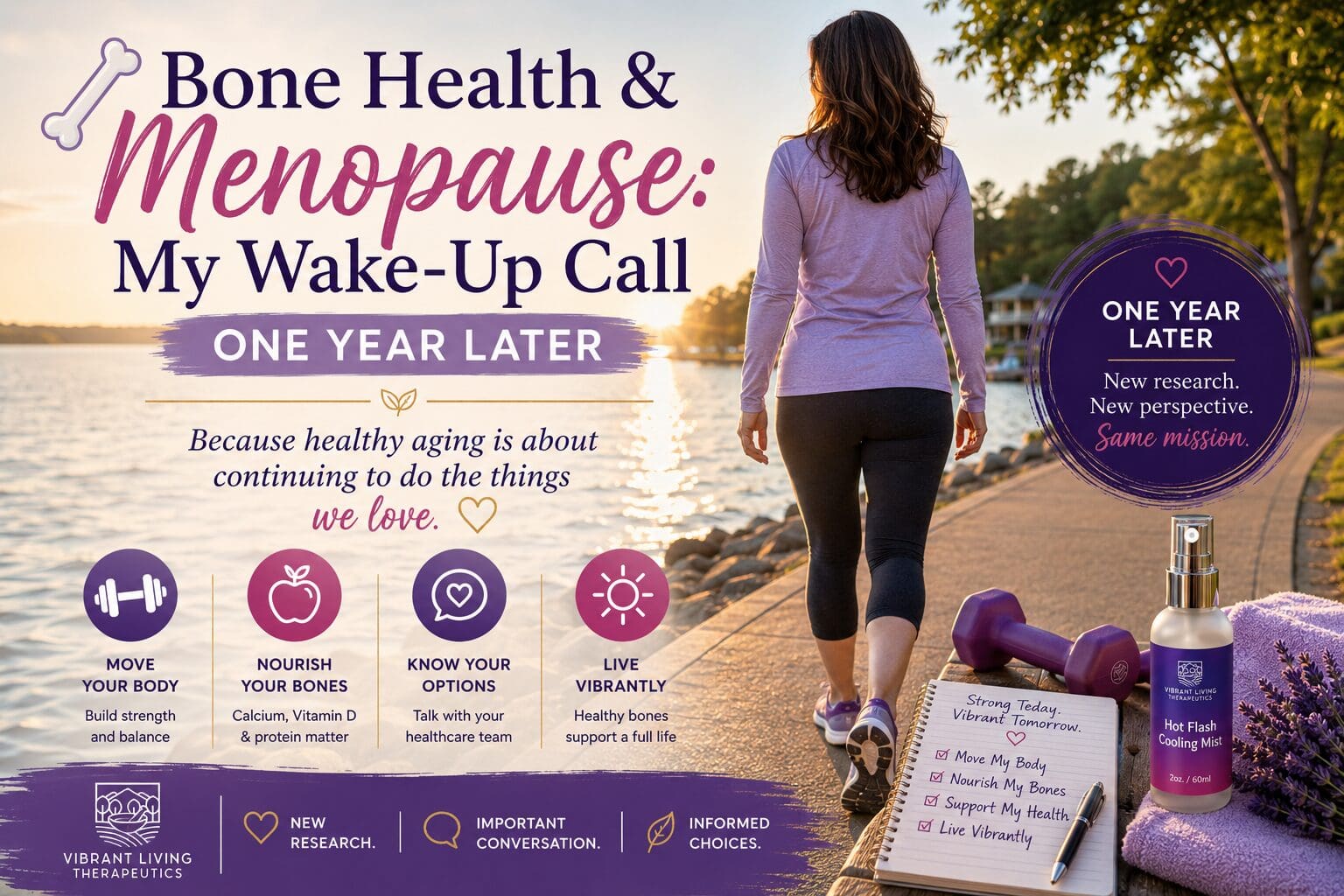
🦴 Bone Health & Menopause: My Wake-Up Call
One Year Later
Editor’s Update – June 2026
When I first wrote about bone health last October, I thought of it as something “out there”, a risk women face after menopause. Then my bone scan showed osteopenia. Suddenly, bone health became personal. A year later, I’m revisiting this conversation with new research, new perspective, and the same mission: helping women age vibrantly and make informed choices about their health.
Recently presented data at ENDO 2026 suggested that postmenopausal women receiving menopausal hormone therapy had lower rates of low bone mineral density compared with women not receiving hormone therapy. While these findings do not mean hormone therapy is appropriate for everyone, they reinforce an important message: menopause affects much more than hot flashes and sleep, it also affects our bones.
As both a pharmacist and a woman navigating menopause myself, I continue to believe that understanding our individual risk factors and having informed conversations with our healthcare teams are essential. And perhaps most importantly… Don’t wait until your bone scan becomes your wake-up call.
When Bone Health Becomes Personal: Osteopenia is the stage before osteoporosis, when bone density is lower than normal but not yet in the fracture-risk zone. Many women don’t know they have it until they have a bone density scan (DEXA). I certainly wasn’t expecting my results. Like many women, I felt healthy and active. Yet there it was—my reminder that bone loss is often silent but very real.
As women transition through menopause, declining estrogen levels can accelerate bone loss. In fact, women may lose up to 20% of their bone density during the first five to seven years after menopause. That’s a sobering statistic. But knowledge gives us an opportunity to act.
What I’ve Learned One Year Later: My osteopenia diagnosis changed the way I think about aging. I pay more attention to: Strength training, Protein intake, Calcium and vitamin D, Staying active, Discussing my options with my healthcare providers.
I’ve also realized something important. Bone health isn’t simply about preventing fractures decades from now. It’s about preserving our ability to travel, carry grandchildren, walk around the lake, dance at weddings, and continue doing the things we love. Because healthy aging isn’t simply about living longer. It’s about continuing to live vibrantly.
Building Strong Bones: Small Habits Matter: Bone health isn’t determined by one decision. It’s the result of small, consistent habits practiced over time. Some ways to support bone health include: Participating in regular weight-bearing and resistance exercise, Prioritizing adequate calcium, vitamin D, and protein intake, Staying physically active throughout life, Discussing risk factors and treatment options with your healthcare provider, Completing recommended bone density screenings. I’ve learned that small changes, practiced consistently, can make a meaningful difference.
A Pharmacist’s Perspective: As pharmacists, we often talk about prevention. Bone health is another reminder that prevention matters. Menopause affects much more than hot flashes and sleep. It affects our muscles, our balance, our strength, and our bones. The encouraging news is that women have options. For some women, menopausal hormone therapy may be an appropriate consideration. For others, lifestyle modifications, nutritional support, exercise, or osteoporosis medications may play an important role. The best approach is always individualized.
Final Thoughts: A year ago, my osteopenia diagnosis felt like a wake-up call. Today, I see it differently. I see it as an invitation. An invitation to become stronger. More intentional. More informed. And even more grateful for the ability to keep doing the things I love. If you haven’t had a conversation about bone health with your healthcare provider, consider starting one. Knowledge is power. Strong bones are the foundation for living vibrantly, with freedom, confidence, and independence. Because healthy aging isn’t about avoiding life. It’s about continuing to embrace it. 💜
References: The Menopause Society (formerly North American Menopause Society). Menopause Practice: A Clinician’s Guide. 7th ed. Cleveland, OH: The Menopause Society; 2024. The Menopause Society. Management of Osteoporosis in Postmenopausal Women: Position Statement. Menopause. 2021. National Institutes of Health Osteoporosis and Related Bone Diseases National Resource Center. Osteoporosis Overview. Updated 2025. American College of Obstetricians and Gynecologists (ACOG). Osteoporosis Prevention, Screening, and Diagnosis. Patient FAQ. Updated 2025. Endocrine Society. Pharmacological Management of Osteoporosis in Postmenopausal Women: Clinical Practice Guideline. Espinoza-Peralta D, et al. Real-World Study Backs Menopausal Hormone Therapy for Stronger Bones. Presented at ENDO 2026, Endocrine Society Annual Meeting, Chicago, Illinois. MedPage Today. Real-World Study Backs Menopausal Hormone Therapy for Stronger Bones. Published June 17, 2026.
Pharmacist’s Note: Bone health is influenced by many factors, including age, genetics, hormonal changes, nutrition, physical activity, and certain medications. Decisions regarding bone density testing, menopausal hormone therapy, and osteoporosis treatment should always be individualized and discussed with your healthcare provider.